












_category.original.jpg)



_category.original.jpg)









Sold Out
Piano Accordions
Piano Accordions
learn more
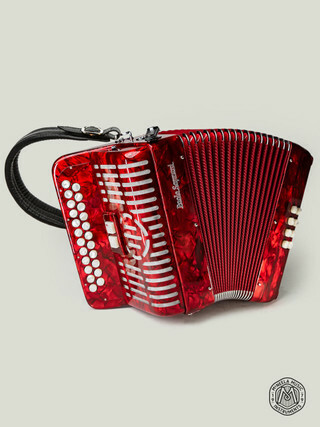
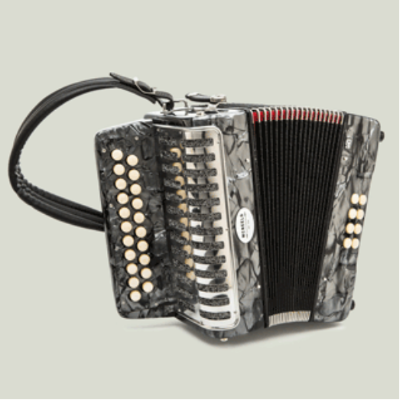
A piano accordion with piano keys uses a standard keyboard layout on the treble (right-hand) side, exactly as you’d find on any piano or keyboard instrument. The left hand operates the Stradella bass system: rows of buttons covering individual bass notes, major chords, minor chords, seventh chords, and diminished chords, giving the player a complete harmonic toolkit without needing to read a separate bass clef.
It’s the accordion type most commonly used in classical music, jazz, French musette, Eastern European folk, and music education worldwide. Its keyboard layout makes it immediately legible to anyone who has played piano, keyboard, or organ; the note positions are already in muscle memory. The learning curve shifts to bellows technique and bass navigation, not a new note system.
Piano accordions come in a wide range of sizes, from compact 48-bass student models to full 120-bass concert instruments. The right size depends on the player’s body, musical ambitions, and how much weight they can comfortably manage. The full accordion range at McNeela covers all types and levels for players whose paths lead in different directions.
Piano accordion vs button accordion: which is right for you
This is the single most useful question to answer before buying, and the answer comes almost entirely from the music you want to play.
Piano accordions suit players who want broad versatility across genres, who already have keyboard experience, or who are entering music education where piano accordion is the taught standard. Their keyboard layout is familiar, they’re widely available in different sizes, and they cover a genuinely wide range of musical traditions. For players drawn to classical, jazz, musette, or world folk styles, the piano accordion is the natural choice. For a deeper comparison of the full button accordion family and how it differs technically, the dedicated page covers it in full.
Button accordions specifically the two-row B/C and C#/D instruments are the standard instrument of Irish traditional music. They’re lighter, quicker in the treble, and produce a tone experienced trad players describe as simply right for the music. If Irish trad is what draws you to the accordion, a beginner button accordion is the correct starting point not this page.
This isn’t a quality judgement. Neither instrument is better than the other. They serve different musical worlds, and choosing between them is a genre decision first and everything else second.
Find Your Fit
| Your situation | Recommended Type | Why it Fits |
| Piano player wanting to add accordion to your playing | The keyboard layout you already know learning curve is bellows and bass only | |
| Interested in classical, jazz, or continental | Piano accordion is the standard instrument across these traditions | |
| European folk Drawn to Irish traditional music and session playing | Button accordion is the instrument Irish trad is built around | |
| Complete beginner, genre undecided, want broad musical options | Most widely taught in music education; compact models are manageable from day one | |
| Starting from scratch, drawn specifically to Irish trad | The standard starting point for Irish trad sessions, tuition, and repertoire built around it |
What to look for in a piano accordion
The most important decision at this stage is size. The number of bass buttons on the left-hand side is the clearest guide: a 48-bass instrument is compact and manageable, covering the essential chords and bass notes a beginner or intermediate player needs. A 72-bass model extends that range. A 96-bass covers virtually every practical musical situation. A full 120-bass concert instrument offers the widest range of all but it’s also the heaviest, and carrying that weight through a learning period before technique and stamina are developed is counterproductive. Compact is the right starting point for most beginners.
Treble range follows the same logic. Student models offer around 26 keys; full-size instruments go to 41. More keys means wider melodic range but also a wider, heavier instrument.
Voices work on the same principles as button accordions: 2-voice is brighter and lighter, 3-voice or 4-voice delivers richer harmonic depth. Piano accordions at this level often include register switches, tone levers for changing reed combinations mid-performance. Hand-finished reeds, as across all accordions, produce clearer, more stable tone with better response at speed.
Weight is worth taking seriously at any level. Piano accordions are generally heavier than equivalent button accordions, and a strap setup that distributes weight properly makes a genuine difference over a long practice session or performance. The right accordion accessories, broader shoulder straps, a back strap or harness for heavier models make the difference between an instrument you enjoy playing and one you fight against.
McNeela’s piano accordion range
McNeela’s core expertise is Irish traditional music and button accordions; that's where four decades of instrument-making knowledge sits deepest. The piano accordion range is selected with the same quality standards that apply across all McNeela instruments, for players whose musical interests run broader.
The range runs from compact student models for beginners through to mid-range instruments for developing players. For players at the top of this collection, Paolo Soprani with over a century of Italian accordion-making heritage also produces piano accordions alongside its legendary button accordion range. Players moving from beginner to more capable instruments can also explore the intermediate and advanced accordion collections for what’s available at each tier.
Every piano accordion in this collection ships with a quality gig bag and access to the Benny McCarthy Irish Accordion Masterclass. All new instruments carry a one-year guarantee against material defects, with servicing available beyond the first year for a nominal fee. McNeela offers a 30-day try-at-home on all instruments particularly valuable when buying an accordion online rather than in person. Shipping runs next day within Ireland, three to five days to the UK, and around seven days to Europe and worldwide. Players in Dublin are welcome at the Baldoyle Industrial Estate showroom to try instruments before committing. For further guidance on choosing the right accordion, Paraic’s accordion buyer’s guide covers the full decision in plain terms.
Frequently Asked Questions
A piano accordion uses a standard piano-style keyboard on the treble (right-hand) side and the Stradella bass system on the left, covering individual bass notes and chord buttons across all keys. It’s the accordion type most commonly used in classical music, jazz, musette, and music education, and the most familiar starting point for players with prior keyboard experience.
For players with piano or keyboard experience, yes the treble layout is already in muscle memory, so the learning curve shifts to bellows technique and bass navigation. For players starting from scratch with no keyboard background, neither instrument is inherently easier. Genre should drive the choice more than perceived difficulty.
A 48-bass or 72-bass compact model. These are lighter, more manageable in the hands, and build technique and confidence faster than a full-size 120-bass instrument. The full range becomes useful once playing is established, starting compact is almost always the better decision at the beginner stage.
The number refers to the bass buttons on the left-hand side. A 48-bass covers the essential chords and bass notes for most playing situations. A 120-bass offers the full harmonic range for concert and professional use. More bass buttons means more musical options but also more weight and a wider instrument to manage.
Technically yes, but the button accordion is the standard instrument for Irish trad. Most tuition, sessions, and recordings are built around the B/C two-row button box. If Irish traditional music is your primary interest, McNeela’s beginner button accordion range is the right starting point.
The standard bass layout on most piano accordions. Buttons are arranged in rows covering single bass notes, major chords, minor chords, seventh chords, and diminished chords, giving the left hand a full accompaniment system across all keys. It’s the most widely taught bass system in accordion education worldwide.
Prioritise manageable size (48–72 bass), quality reeds, and a weight you can comfortably hold for extended playing. Register switches are a useful feature but not essential at the beginner stage. Avoid buying the largest instrument available; compact models build technique faster and are significantly easier to manage when starting out.
McNeela’s core expertise is Irish traditional music and button accordions, where four decades of instrument knowledge sits deepest. The piano accordion range is selected with the same quality standards for players whose musical interests extend beyond Irish trad. Every instrument ships with a gig bag and Benny McCarthy Masterclass access.


Loading...